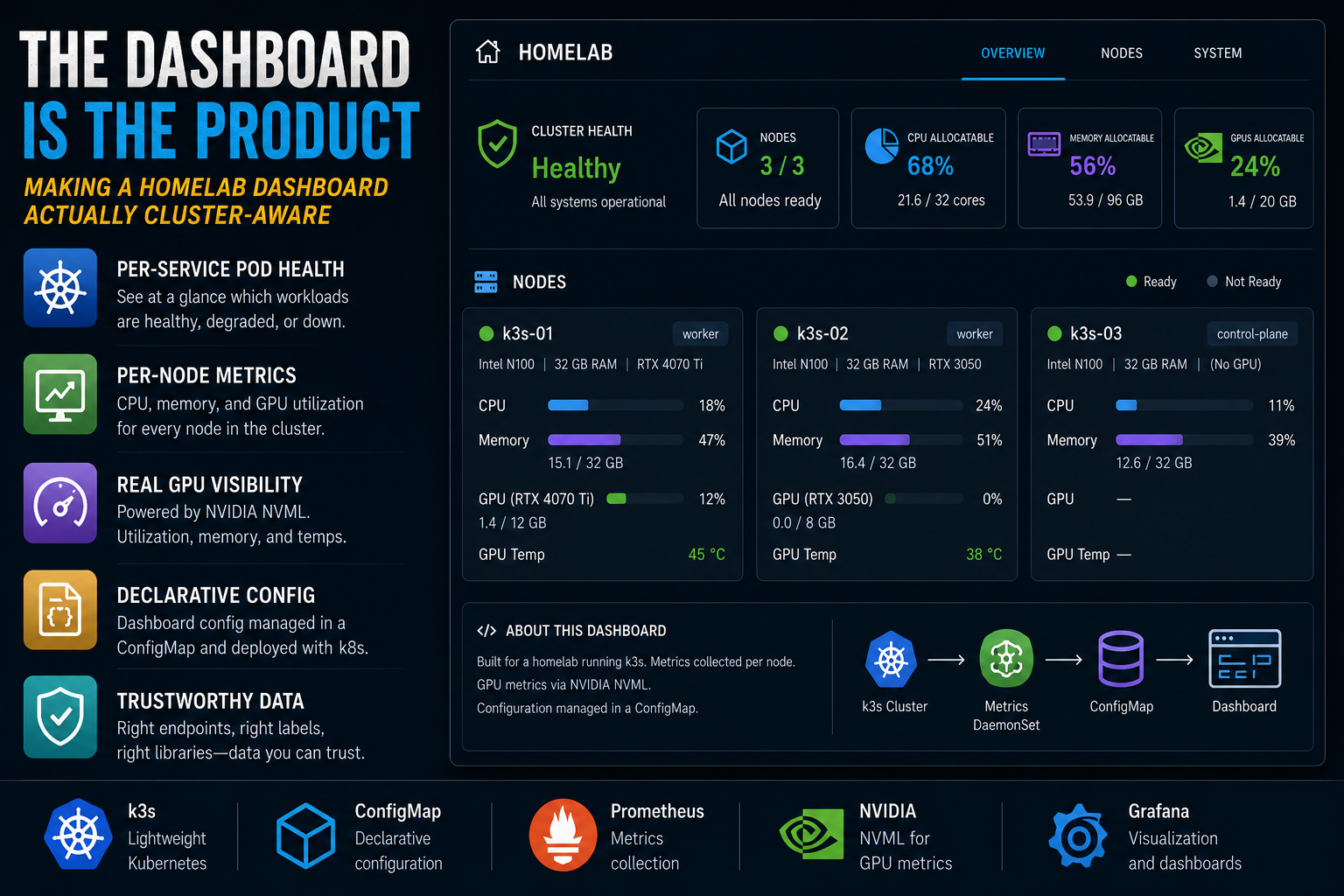
Read more about the article The Dashboard Is the Product: Making a Homelab Dashboard Actually Cluster-Aware
The Dashboard Is the Product presents a cluster-aware homelab dashboard with pod health, node health, and resource widgets for CPU, memory, and GPU.

The Dashboard Is the Product: Making a Homelab Dashboard Actually Cluster-Aware

When I moved my homelab from a collection of Docker workloads to a three-node k3s cluster, getting the applications running was only part of the migration. I also wanted the dashboard I use to get into everything to understand the cluster underneath it. A traditional homelab dashboard is mostly a…

0 Comments
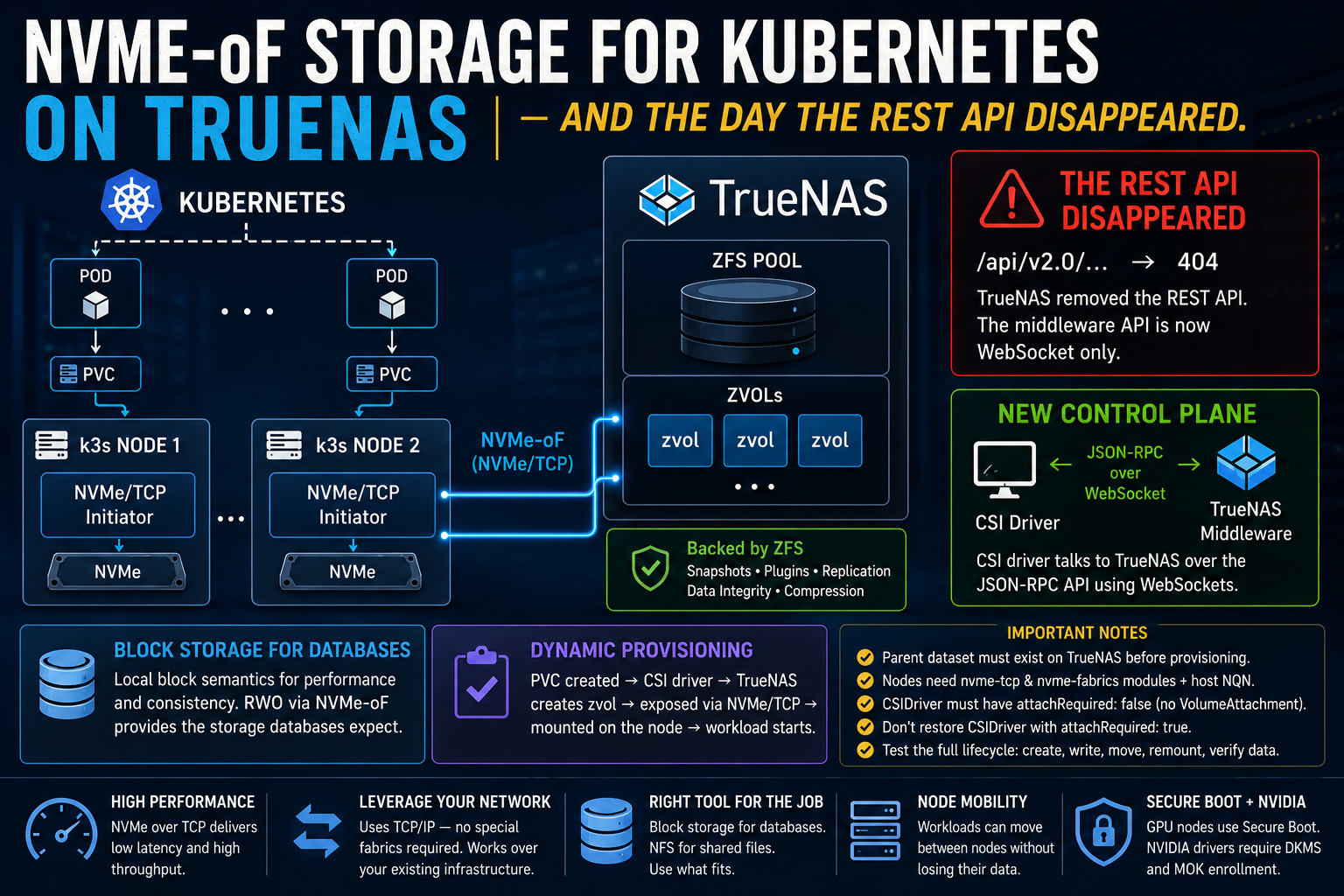
Read more about the article NVMe-oF Storage for Kubernetes on TrueNAS — and the Day the REST API Disappeared
The diagram maps Kubernetes PVCs to TrueNAS zvols over NVMe/TCP and notes a missing REST API that changed the storage approach for the k3s cluster.

NVMe-oF Storage for Kubernetes on TrueNAS — and the Day the REST API Disappeared

When I moved my homelab workloads from a single Docker host into a three-node k3s cluster, persistent storage was one of the architectural decisions I wanted to get right early. Most of the persistent data already lived on TrueNAS, so Kubernetes didn't need to become a storage platform itself. What…

0 Comments
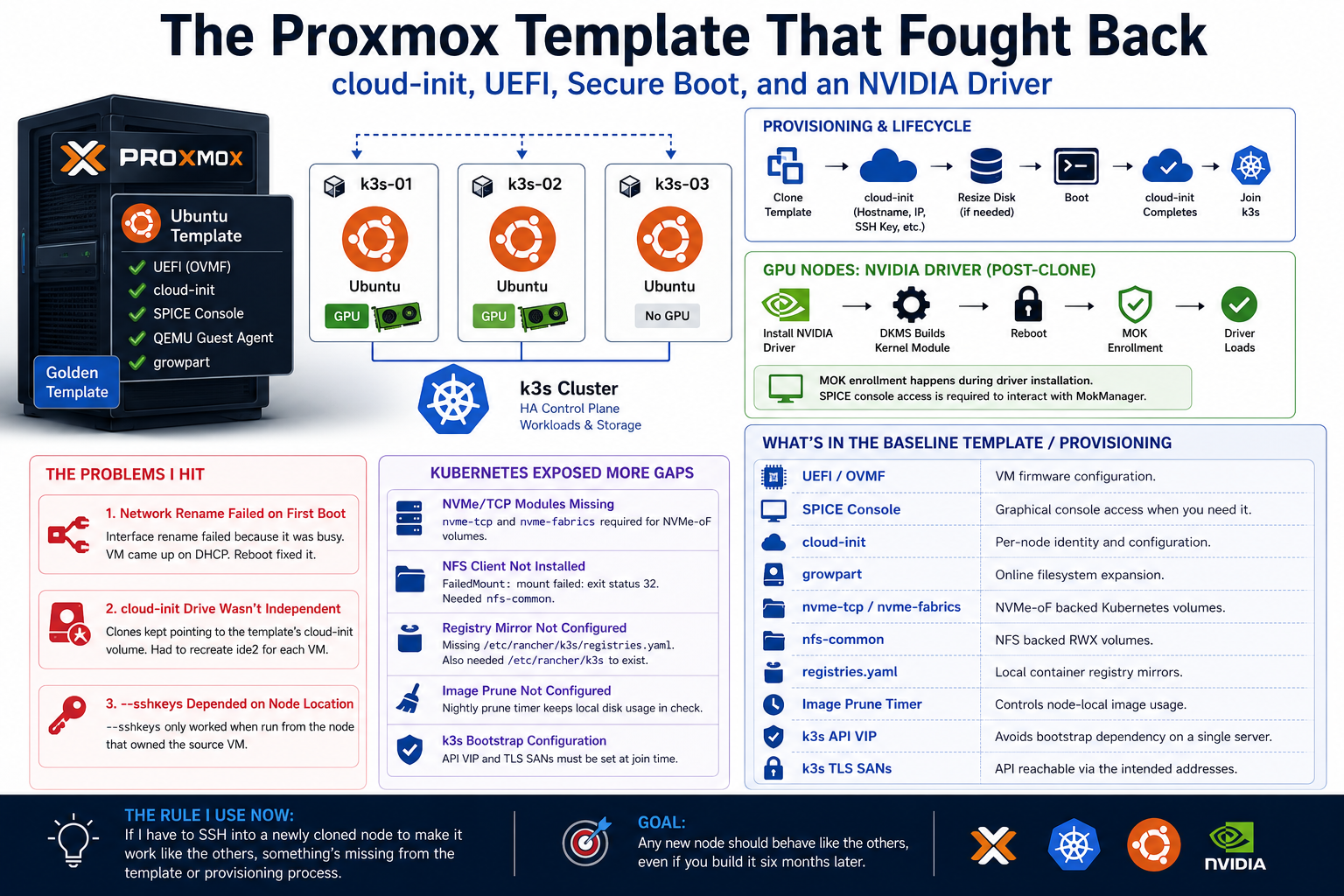
Read more about the article The Proxmox Template That Fought Back: cloud-init, UEFI, Secure Boot, and an NVIDIA Driver
The Proxmox Template That Fought Back outlines a reproducible Ubuntu cloud-init build for k3s nodes, including UEFI, Secure Boot, and NVIDIA driver setup.

The Proxmox Template That Fought Back: cloud-init, UEFI, Secure Boot, and an NVIDIA Driver

When I rebuilt my Docker homelab as a three-node k3s cluster, one of the requirements was reproducibility. The Kubernetes nodes are Ubuntu VMs running on Proxmox. I needed three nodes initially, with the possibility of adding a fourth later. Installing and configuring Ubuntu manually on every VM would work, but…

0 Comments
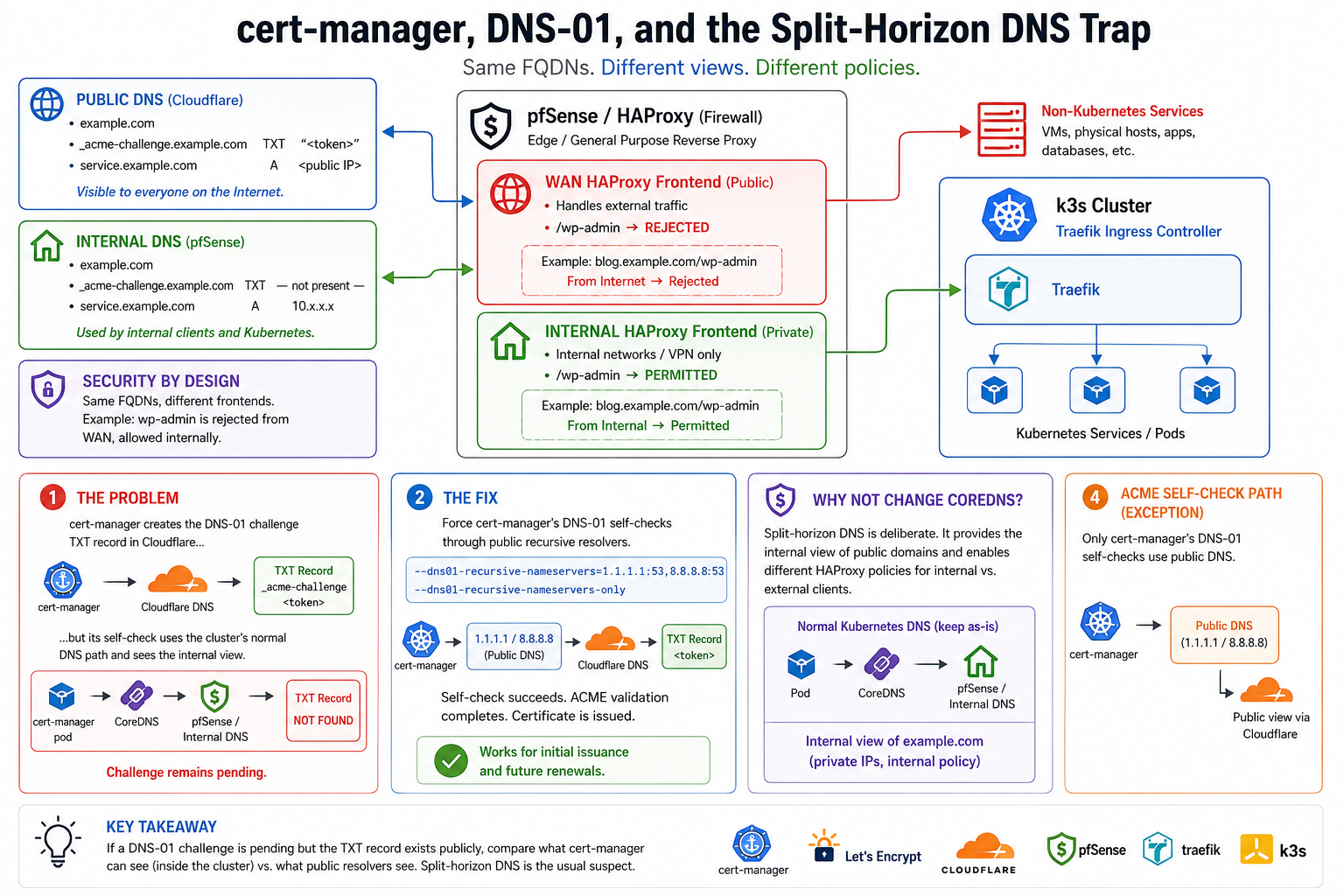
Read more about the article cert-manager, DNS-01, and the Split-Horizon DNS Trap
The diagram explains how HAProxy on pfSense fronts homelab traffic while cert-manager uses Cloudflare DNS-01 to issue a wildcard certificate for k3s and Traefik.

cert-manager, DNS-01, and the Split-Horizon DNS Trap

I use the same public domain for services across my homelab, but those services don't all live in Kubernetes. HAProxy runs on my pfSense firewalls and remains the general-purpose reverse proxy for the environment. It handles public ingress and also fronts services running outside Kubernetes. Inside my k3s cluster, Traefik…

0 Comments
Read more about the article Chasing a 60-Second Flap Through Four Layers: From a Red Dashboard to etcd fsync
The dashboard shows a brief Uptime Kuma outage pattern that leads back through k3s, Traefik, and storage latency to etcd fsync delays.

Chasing a 60-Second Flap Through Four Layers: From a Red Dashboard to etcd fsync

Both before and after moving most of my homelab workloads onto k3s, I started seeing intermittent outages in Uptime Kuma. Moving to k3s helped, but didn't fully resolve it. There wasn't an obvious pattern. Different services would occasionally show approximately 60 seconds of downtime, then recover without intervention. The affected…

0 Comments